Collate Meaning: Definition, Uses, and Examples
Understanding the meaning of “collate” is essential when working with documents, printing, research, or data organization. Although the term appears frequently in printer settings and office workflows, many people are unsure what it actually means or when to use it. At CollateMeaning.com, our goal is simple: to explain the meaning of collate in clear, practical terms. This guide covers its definition, real-world uses, printing applications, and the difference between collated and uncollated documents.
This page is a complete, easy-to-understand guide to the meaning of collate. Whether you are a student, office worker, business owner, or simply curious, this resource explains what collate means, how it is used in printing, and how collated and uncollated documents differ.
Our goal is simple: to give you the clearest explanation of collate meaning available online.
What Does Collate Mean?
Collating works by arranging items according to a predetermined sequence. The process involves more than simply collecting items. The process requires proper organization of items into logical arrangements.
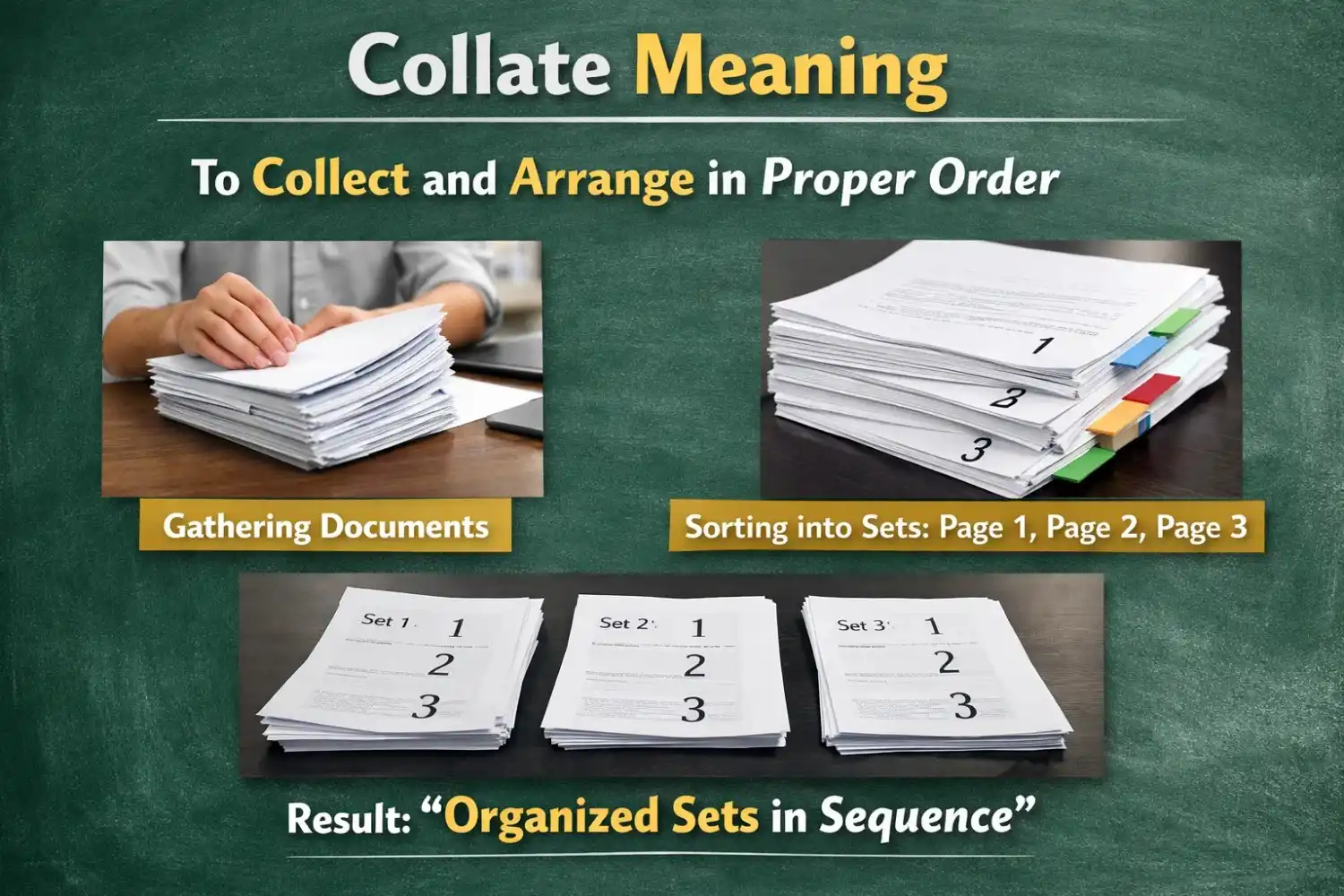
When you collate documents, you need to arrange the pages in their correct sequence. This method enables you to create a complete document that is ready for distribution. No extra sorting needed.
People usually think of collating with printing, but it fits many situations. Anywhere you need to organize information or paperwork, collating can assist.
General Meaning of Collate
In general usage, collate refers to three closely related actions:
- Collecting separate items
Bringing together individual pieces that belong to the same group. - Comparing or checking information
The process of reviewing multiple sources allows us to find differences, errors and inconsistencies between them. - Organizing content into a structured order
The process of arranging items requires to create a sequence that follows clear logical patterns.
The different meanings of this term all describe the same basic concept of connecting related things and organizing them in a particular sequence.
Everyday Examples of Collation
Here are some everyday examples of collation.
- A teacher collates tests before grading to ensure all pages are there.
- A researcher collates data from studies to compare results and reach sound conclusions.
- An office worker collates printed pages into complete documents before giving them out.
- A publisher collates manuscript pages to check that chapters are in the correct order before printing.
In all these situations, collation prevents confusion, missing info, and mistakes.
Collate Meaning in Simple Terms
To collate means to assemble things in order. The collation process organizes your numerous pages, files, and data elements into proper groups. This maintains a sequential order from beginning to end.
You need to print multiple copies of a report which contains five pages. Collation puts each copy in the proper sequence. Without it, pages can get mixed up, which makes the copies unclear or useless. This simple idea is why collation matters so much in schools, offices, and print shops.
Why Collation Is Important
The process of collating plays an intricate role in maintaining clarity and efficiency, especially when it comes to dealing with huge masses of information.
Without collation:
- Pages may be out of order
- Documents may be incomplete
- Information may be difficult to follow
- Time is wasted reorganizing materials
With proper collation:
- Documents are easy to read and understand
- Workflows become faster and more organized
- Errors and misunderstandings are reduced
The only variance between those categories would counsel that, due to the confusion of collecting, the descriptor would mean helping some specific individuals to arrange information together.
The Origin and Definition of Collate
The word collate comes from the Latin term collatus. Which means to bring things together. The term collation has its roots in this origin. Which describes the process of organizing different items into a structured collection.
The word has changed over time and is now frequently used in schools, offices, and the publishing business. As printing technology developed, collate became closely associated with document handling and page order.
Dictionary Definitions of Collate
- To collect and combine texts or information
- To arrange pages or documents in sequence
- To compare and verify written material
The different definitions of the same concept, which defines organization through proper grouping and systematic arrangement. The process of collating in academic environments requires scholars to examine multiple text versions for comparison. The process of collating in offices and printing centers emphasizes the correct arrangement of pages and documents.
Modern Usage of Collate
The term collate has become common in office and school settings because people use it to discuss document printing. Most printers, word processors and PDF programs include a collate feature which allows users to print multiple copies of documents in an organized manner.
However, the term is not limited to printing. Collation also applies to:
- Digital documents
- Data organization
- Research compilation
- File management
In all modern uses, the goal remains the same: bringing related content together in an organized, meaningful order.
Collate vs Simple Collection
Collating requires more than item collection because it involves different procedures. The process of collating pages requires more than their simple collection into one location.
Collation requires:
- Correct order
- Logical structure
- Completeness
For example, stacking pages randomly is not collation. Arranging them from page one to the final page is.
What Does Collate Mean When Printing?
The definition of collate in printing exists as one of the most popular online search queries. Most people do not understand the collate function because modern printers and software applications provide this feature as a standard option. The collate function controls the printing process when multiple document copies need to be produced.
When printing, collate determines how multiple copies of a document are printed.
Example of Collated Printing
You need to print a document that contains three pages, and you require two copies of it.
With the collation function active, the printer produces:
- Copy 1: Page 1, Page 2, Page 3
- Copy 2: Page 1, Page 2, Page 3
The distribution contains complete copies, which are ready for immediate use.
Example of Uncollated Printing
With collation turned off, the printer produces:
The printer produces two copies of each printed page when collation functions are disabled. You need to arrange the pages into complete sets, which must be done through your own efforts.
- Page 1, Page 1
- Page 2, Page 2
- Page 3, Page 3
This means you must manually arrange the pages into complete sets.
Collated vs Uncollated: What’s the Difference?
Collated Printing
- Produces complete document sets in order
- No manual sorting required
- Professional appearance
Uncollated Printing
- Prints identical pages together
- Useful for binding or custom assembly
- May print faster on some machines
When Should You Use Collation?
You should use collation when:
- You want to print all copies of multi-page documents together.
- You are preparing handouts for groups.
- Distributing reports or assignments
- Printing presentations
You may avoid collation when:
- Printing pages for binding
- Manually assembling documents
- Printing single-page copies
Why Collation is Important for Offices and Businesses
Your document organization method at work determines your work productivity and your professional appearance.
- Better efficiency: The efficiency of the process improves when all documents are prepared for immediate use.
- Fewer mistakes: Having the pages in the right order helps avoid mix-ups.
- Looks Pro: Organized documents show you're reliable.
Collate Meaning in Digital Documents
Collation also applies to digital document handling, including:
- Merging files
- Organizing scanned documents
- Comparing versions
- Structuring reports
Common Mistakes People Make with Collation
- Printing without checking settings
- Assuming collation is automatic
- Confusing collate with sort
Collate vs Sort
The role of collating is bringing together separate pages to form coherent sets, while sorting is one that brings some order within sets of data, according to some criterion, such as alphabetical or numerical sequence.
Frequently Asked Questions About Collate Meaning
What does collate mean on a printer?
It means printing multiple copies in complete, ordered sets.
Should I collate when printing multiple copies?
Yes, if you want each copy ready for immediate use.
Does collating affect print quality?
No, it only affects page order.
Final Thoughts on Collate Meaning
In conclusion, knowing what collate means can really improve how you handle documents, on paper or online. In places like offices, schools, print shops, and publishing companies, collation makes sure information is clear and looks professional.
This page serves as the foundation of collatemeaning.com; a dedicated resource designed to explain collate clearly, accurately, and practically.