
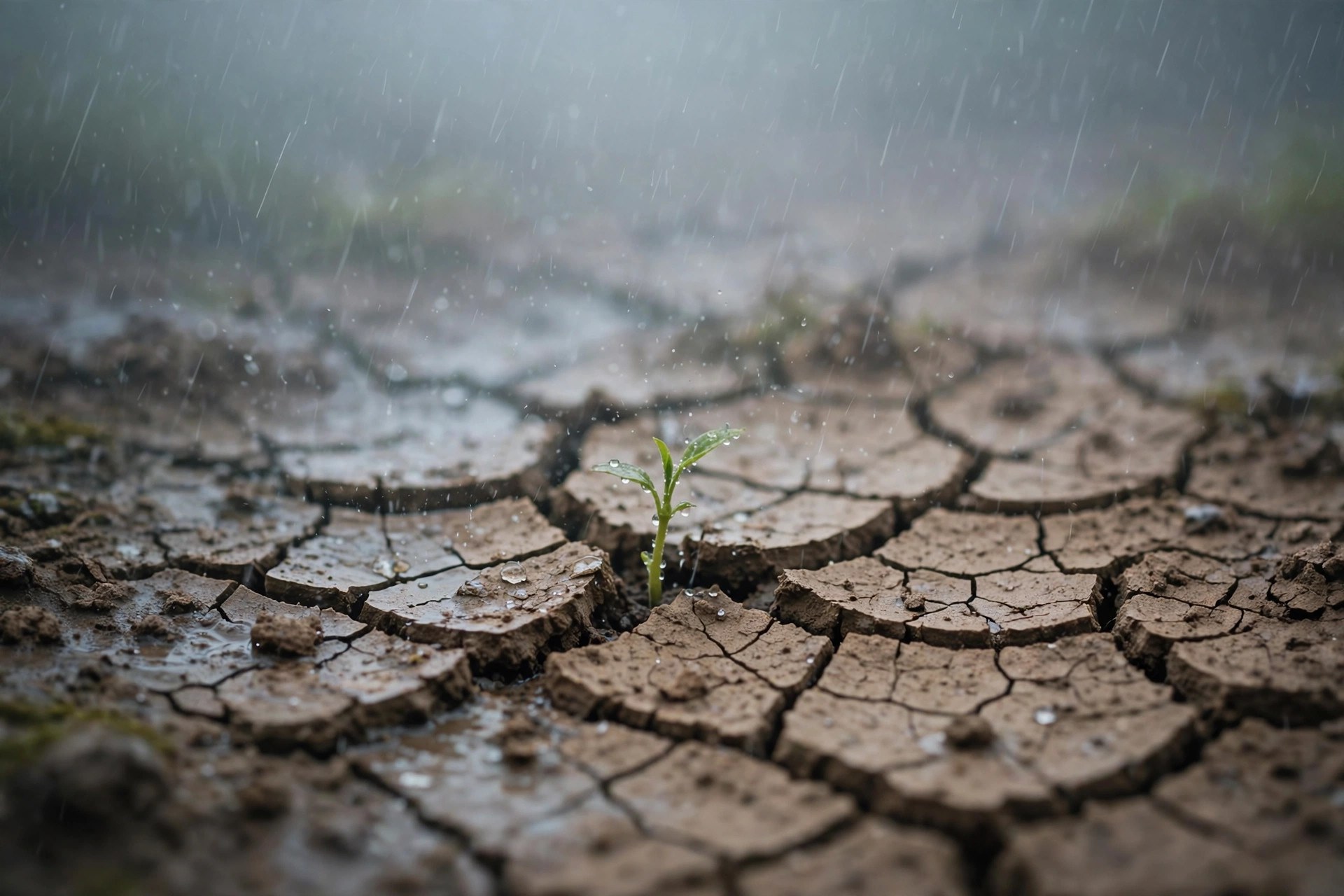
There is a smell that belongs only to the first minutes of rain: warm, earthy, faintly sweet, rising from dry pavements and dusty soil the moment the drops begin to fall. It is one of the most loved scents in the world, and it has its own name. If you have ever wondered what does petrichor mean, the answer is simple — it is the name of that smell, the scent of rain on dry earth. For another unusual word, see what snow bunny means. But behind the pretty word is a surprising piece of science involving plant oils, soil bacteria, and one of the most sensitive noses in the animal kingdom: our own.
What Does Petrichor Mean?
Petrichor (pronounced PET-ri-kor) is a noun meaning the distinctive, earthy scent produced when rain falls on dry soil or rock, especially after a long dry spell — a meaning as specific as serendipity’s; see what serendipity means. It is the smell you notice when a summer shower begins — dusty and fresh at the same time, a little like wet earth mixed with green leaves. The word refers to the scent itself, not to the rain: a heavy downpour on already soaked ground produces far less of it than a light shower after a week of sun.
The word is unusual in English because it was invented deliberately, by scientists, rather than growing slowly out of everyday speech. That gives it a precise meaning and a clear birthday, both of which we will look at below. Bomboclat is another word with a precise meaning and a colourful history — see what bomboclat means. It is also one of those words that people love simply for the way it sounds — soft and rain-like — and it regularly appears on lists of the most beautiful words in the English language.
Because it names a specific experience that everyone knows but few could describe, petrichor has become a favourite word of writers, poets, and anyone who wants to capture a summer rainstorm in a single word. Saying “the petrichor after the storm” does in two words what a whole sentence would otherwise be needed for.
The Origin of the Word Petrichor
Petrichor was coined in 1964 by two Australian researchers, Isabel Joy Bear and Richard Thomas, who worked for the Commonwealth Scientific and Industrial Research Organisation (CSIRO). They introduced the word in a paper published in the journal Nature, in which they described their investigation into the source of the smell of rain.
They built the word from two Greek roots. Petra means stone or rock, and ichor is the word from Greek mythology for the golden fluid that flowed in the veins of the gods instead of blood. Put together, petrichor means something like “the blood of the stone” — the scent that stone itself seems to give off when rain touches it. It is a poetic name for a scientific discovery, and that combination is part of why the word has survived so well.
Bear and Thomas were not the first people to notice the smell, of course — farmers, poets, and anyone who has lived through a dry summer have known it for centuries. What the two scientists did was give the phenomenon a name and explain what caused it, turning a familiar pleasure into a subject of proper scientific study.
What Causes the Smell of Rain?
The smell of rain has not one cause but three, and they work together. The first is plant oil. During dry weather, many plants release oils from their seeds and leaves. These oils collect in the soil and in the pores of rocks, where they sit, trapped, until rain arrives. When raindrops hit the ground, they release tiny bubbles of air that carry the oil upwards as an aerosol — and that aerosol is what your nose detects as the fresh, earthy note of petrichor.
The second cause is a compound called geosmin, which is made by common soil bacteria known as actinobacteria (including the genus Streptomyces, which gives soil much of its smell). When the soil dries out, these bacteria produce spores; when rain falls, the spores are released into the air along with geosmin. The human nose is extraordinarily sensitive to geosmin — we can detect it at concentrations of just a few parts per trillion, which is more sensitive than a shark is to blood in water. Scientists think this sensitivity may be an evolutionary leftover: for our ancestors, the smell of rain meant water was coming, and finding water quickly could mean survival.
The third ingredient is ozone. During thunderstorms, lightning splits oxygen and nitrogen molecules in the air, and some of them recombine as ozone, which has a sharp, clean, slightly metallic smell. Ozone is carried down to ground level by the rain, adding a crisp note to the softer earthiness of the plant oils and geosmin. Together, the three create the scent we recognise instantly as “rain”.
One curious detail: the smell is strongest at the start of the rain and fades quickly. That is because the oils and spores are released in a burst when the first drops hit, and once they are washed away there is little left to smell. It is also strongest after a long dry spell, because more oil has had time to build up in the soil — which is why the first rain after a drought smells so much more powerful than rain in the middle of a wet week.
Why Do We Love the Smell of Rain So Much?
Almost everyone likes the smell of rain, and the reasons are a mix of biology and memory. The biological part is the one described above: our noses are tuned to geosmin, and the scent may have signalled safety and survival to our ancestors. Rain after drought meant drinking water, growing crops, and relief from heat — so a fondness for the smell would have been a useful trait to have.
The personal part is just as important. Smell is the sense most closely tied to memory, and for many people petrichor is linked to childhood summers, holidays, the sound of rain on a tent, or the moment a heatwave finally broke. Those associations make the scent feel comforting and nostalgic in a way that is hard to explain but easy to recognise.
There is also something about the timing. Petrichor arrives at a moment of change — the heat breaks, the dust settles, the air turns cool. It marks the end of something uncomfortable and the start of something fresh, and that feeling of relief is part of what we are enjoying when we stop and breathe it in.
How to Use Petrichor in a Sentence
Petrichor is a noun, and it is most often used on its own or after “the”, usually when describing a scene or a mood. It is a slightly literary word, so it fits best in descriptive writing, nature writing, or conversation where a precise, evocative word is welcome. Here are two example sentences showing it in natural use:
Example 1: “The petrichor rose from the hot pavement as the first drops of the summer storm began to fall, and everyone on the street stopped to breathe it in.”
Example 2: “She opened the windows after the rain to let the petrichor drift through the house, filling every room with the smell of wet earth.”
Because the word is a noun, you cannot use it as an adjective — you would not say “a petrichor day”, but rather “a day full of petrichor” or “the petrichor of a summer evening”. It pairs naturally with words like “after the rain”, “summer”, and “earth”, and it is often used by writers who want to name a feeling that readers already know.
Petrichor in Culture
Since Bear and Thomas gave it a name, petrichor has travelled far beyond science. Poets and novelists use it to set a scene in a single word. Songwriters have borrowed it for titles, and perfumers have tried to bottle it — several fragrances are marketed as capturing the scent of rain on dry earth, though the real thing, with its mix of oils, geosmin, and ozone, is hard to reproduce in a bottle.
The word also has a strong life on the internet, where it appears constantly in lists of beautiful or untranslatable words and in posts by people discovering it for the first time. That popularity is easy to understand: petrichor names something universal, something almost everyone has smelled and loved, and gives it a name that sounds as pleasant as the thing itself.
Part of its charm is that it reminds us how much of our everyday experience still has no name until someone invents one. For centuries, people enjoyed the smell of rain after drought without a word for it. Then two scientists in Australia looked at the phenomenon, worked out what caused it, and gave it a name drawn from ancient Greek. Now the word is used around the world — a small reminder that science and poetry are not as far apart as they sometimes seem.
Frequently Asked Questions
What does petrichor mean in simple terms?
Petrichor is the name for the fresh, earthy smell you notice when rain falls on dry ground after a dry spell. It is a noun, and it describes the scent itself — that pleasant, dusty-sweet smell that rises from soil and pavement in the first minutes of a shower.
What causes the smell of rain?
Three things combine to make it. During dry weather, plants release oils that soak into soil and rocks; rain releases those oils into the air. Soil bacteria called actinobacteria release a compound called geosmin, which the human nose can detect in tiny amounts. And lightning can add ozone, giving the air a sharp, clean note.
Who invented the word petrichor?
The word was coined in 1964 by two Australian scientists, Isabel Joy Bear and Richard Thomas, in a paper published in the journal Nature. They built it from two Greek words: petra, meaning stone, and ichor, the mythical blood of the gods.
Why do humans like the smell of rain so much?
Partly because our noses are extremely sensitive to geosmin, the main scent compound, and partly because of association. For most of human history, rain after a dry spell meant water, crops, and survival, so the smell became linked to relief and comfort. Personal memories of summer rain add to the feeling.
Is petrichor a real scientific term?
Yes. It was created by scientists to name a real phenomenon and is still used in scientific writing about the smell of rain. It has also become popular with writers and word lovers, and it is often listed among the most beautiful words in the English language.
More Articles You’ll Like
Keep reading — more from this category and across the site:
- What Does ‘Lock In’ Mean? Meaning, Origin, and Usage
- How to Package Fragile Food Items for Delivery
- What Is Offset Printing? A Beginner’s Guide
- How to Find Obituaries in Huntsville, AL: A Step-by-Step Guide
- How to Start a Small Business: Step-by-Step Guide for Beginners
- 10 Healthy Lifestyle Habits for a Better Life
- 50 Christmas Knock-Knock Jokes for Kids and Adults