
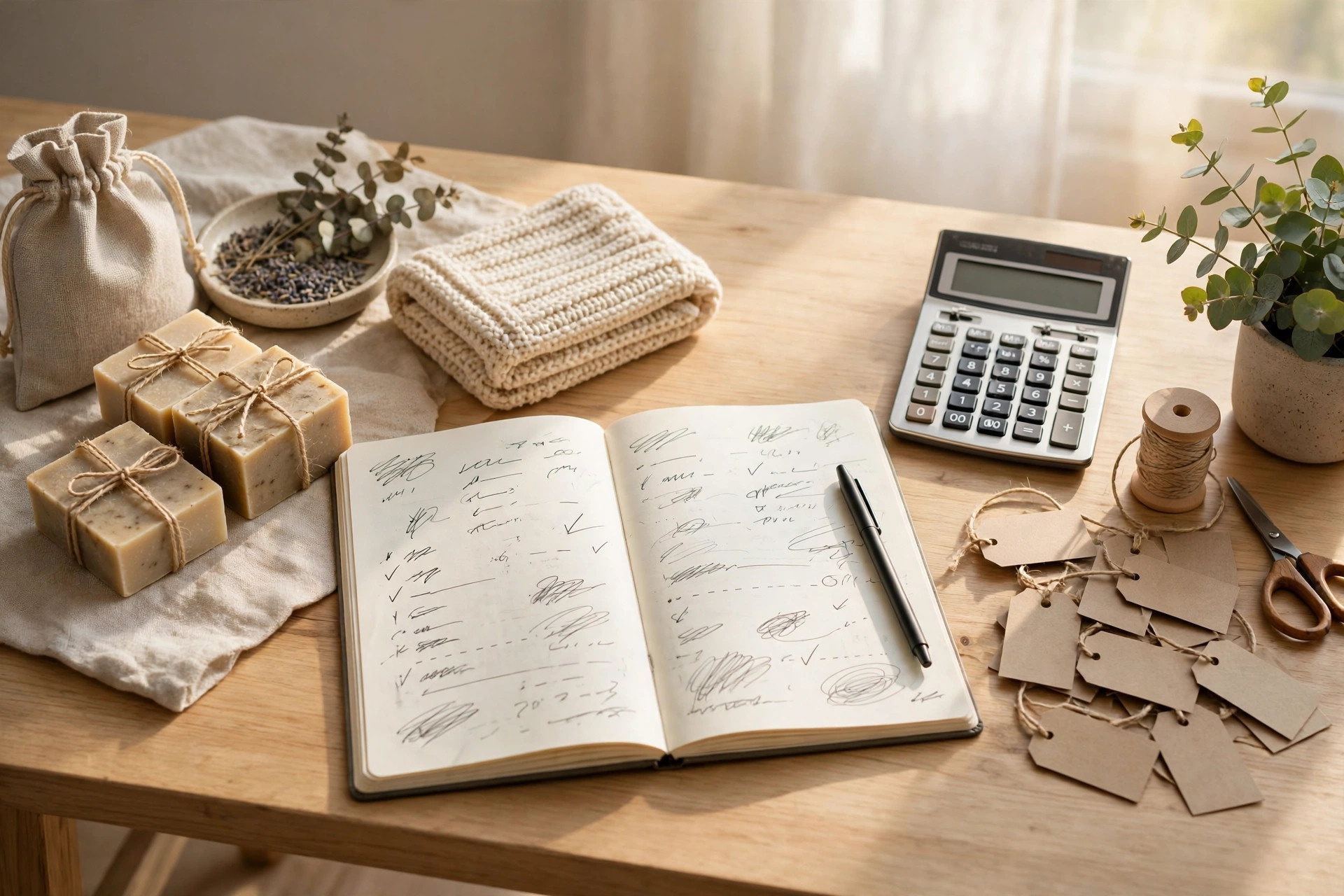
Learning how to price your products is one of the most important skills in running a small business — and one new sellers get wrong most often. Price too low and you work hard for almost nothing; price too high and customers walk past. Pricing is not guesswork: with a clear method you can set a price that covers your costs, earns a fair profit, and still feels reasonable to buyers.
This guide walks through that method step by step. It works whether you sell handmade crafts, baked goods, digital products, or anything in between, and it fits neatly alongside the other early decisions involved in starting a small business, such as choosing what to sell and who to sell it to.
1. Start With Your True Costs
Before you can set a price, you need to know exactly what each product costs you to make and deliver. Many new sellers forget the small costs, and those small costs add up fast.
Start by listing every direct cost for one unit: materials, ingredients, packaging, and any per-sale fees, such as payment processing or marketplace commission. Then add the costs that are harder to see. Your time is the biggest one: if a product takes two hours to make, that time has a value, even if nobody pays you an hourly wage yet. Pick an hourly rate you would be happy to earn and multiply it by the time each item takes.
Do not forget delivery either. Postage, courier fees, and boxes or mailers all come out of your price unless you charge for shipping separately. If you sell food, learning about packaging baked goods for shipping will help you work out the real cost of getting a fragile product to a customer safely.
Finally, add a share of your fixed costs — your website, market stall fee, tools, and subscriptions. Divide your total monthly fixed costs by the number of items you expect to sell and add that amount to each item. The result is your true cost per item, and any price below it means you lose money on every sale.
2. Decide What Profit You Need
Covering your costs is only the first step. A business also needs profit — the money left over after all costs — to grow, to handle slow months, and to pay you properly for your work.
A common starting point is a profit margin of 20 to 50 percent on top of your true cost. Handmade and custom products usually sit at the higher end, because they take more time and skill; simple resold items sit lower, because customers can easily compare them elsewhere.
Here is a simple example. If a candle costs you $6 in materials, packaging, and your time, and you want a 50 percent margin, you would price it at $12. That leaves $6 of profit per candle. If you sell 100 candles a month, that is $600 of profit before fixed costs such as your website and stall fees. If that monthly figure is far below what you need to earn, either your price is too low or you need a product that earns more per sale.
3. Look at What Competitors Charge
Your costs set your floor — the lowest price you can charge without losing money. Your competitors help you find the ceiling — the highest price customers in your market will accept.
Pick five to ten sellers offering something genuinely similar — similar quality, materials, and audience — and note their prices and what is included: size, quantity, packaging, delivery, and extras such as gift wrapping. A $20 candle in a plain jar is not the same product as a $20 candle in a gift box with a handwritten note.
Do not simply copy the cheapest competitor: they may be cutting corners, underpaying themselves, or selling at a loss. Instead, ask where your product sits. If your materials are better or your service more personal, your price can sit above the average. If you are still choosing between small business ideas for 2026, this research is doubly useful: it shows you which markets have room for a new seller and which are already crowded with sellers racing to the bottom on price.
4. Choose a Pricing Method That Fits
There are three common ways to set a price, and most small businesses use a mix of all three.
Cost-plus pricing is the simplest: take your true cost and add your chosen profit margin. It is reliable and guarantees you never sell at a loss, but it ignores what customers will pay, so you can end up charging less than the market would accept.
Competitor-based pricing sets your price in relation to similar products: match the market average, sit slightly below it while you build a reputation, or above it if your quality justifies it. It only works if your costs are lower than the price you match, so check the price against your true cost first.
Value-based pricing sets the price by what the product is worth to the customer. A personalised gift or something made to order can command more than its materials suggest, because the customer pays for the result, not the ingredients. It takes the most confidence, but it usually gives the best margins for handmade work.
For most new sellers, start with cost-plus pricing to find your minimum, check it against competitor prices, and adjust upward if the value you offer justifies it. Pricing is a decision you can revisit, not a promise carved in stone.
5. Test Your Price Before You Commit
You do not need to guess whether a price will work. You can test it with real customers before you commit to it.
Offer the product to a small group first — friends of friends, an email list, a local market stall — at your planned price and watch what happens. If people buy without hesitating, your price may be too low; if they admire it but never buy, the price may be too high or the value unclear. Ask buyers what nearly stopped them: the answer is often about the photos or description rather than the price.
Another useful test is to offer basic, standard, and premium versions at three prices. Many customers choose the middle option, which shows you where the comfortable price point sits and which extras they actually value.
Packaging is part of this test too, because customers judge value partly by how a product looks and feels. Comparing stand-up pouches versus boxes for a food product, for example, changes both your costs and how premium the product feels, which in turn supports a different price. Test the whole offer — product, packaging, and price together — not the price alone.
6. How to Raise Prices Without Losing Customers
Almost every successful small business raises its prices at some point: materials get dearer, skills improve, demand grows. The fear is that customers will leave, but a well-handled rise loses very few and earns far more from those who stay.
First, raise prices for new customers before existing ones: new buyers have no old price to compare against. Give loyal customers a little notice — a short message saying costs have risen and giving the date the new price starts — and many will buy before the rise and pay the new price afterwards.
Second, raise prices in small steps: a 10 percent rise every six months is easier to accept than a 30 percent jump, and it shows you how each change affects sales. Third, add value at the same time — better packaging, a small extra, or faster delivery — so the higher price feels fair.
If you have weighed up glass versus plastic packaging and chosen the dearer option because it protects the product better, say so. Customers respect a seller who can explain why a product costs what it does.
7. Common Pricing Mistakes to Avoid
Avoid copying a big brand’s price: large companies buy in bulk and earn on volume, so their prices say nothing about what a small seller should charge. Avoid pricing by what you would personally pay, too — customers often value the product more than you do, because they see the finished product, not the messy process behind it.
Avoid changing your price every week because of one quiet day or one complaint. Look for patterns over weeks, not reactions over hours. And avoid constant discounting: it teaches customers to wait for a sale and makes your normal price look like an overcharge.
Finally, write your prices down and review them every three months: check your costs, your competitors, and your profit per item, then adjust. Pricing is a habit, not a one-time task. A business that reviews its prices regularly stays profitable; one that sets a price in week one and never looks at it again slowly drifts into working for free.
Frequently Asked Questions
How do I price a handmade product?
Add up materials, packaging, and fees, then add your time at an hourly rate you would accept as a wage. Add a share of your fixed monthly costs, then add your profit margin on top. Check the result against similar handmade products, and adjust the margin rather than cutting your hourly rate.
What is a good profit margin for a small business?
Many small product businesses aim for a gross margin of 20 to 50 percent, with handmade products at the higher end. What matters most is that the margin leaves enough after fixed costs to pay you properly and let the business grow. If it does not, the price or the product needs to change.
Should I charge less than my competitors to win customers?
Usually not. Competing on price alone attracts customers who will leave for the next cheaper seller, and it leaves you with the thinnest margins. Compete instead on quality, service, or presentation. A slightly higher price with a better experience often wins more loyal customers than the lowest price.
How often should I review my prices?
Review them every three months, and whenever a major cost changes, such as a supplier raising prices or postage going up. Small, regular reviews mean small adjustments customers barely notice, instead of one large increase.
What if customers say my product is too expensive?
First, check whether the value is clear: do your photos, description, and packaging show why the product is worth its price? If they do and people still object, the product may be aimed at the wrong audience, or the price may genuinely be too high. Ask what price they expected, then decide on evidence rather than one comment.
More Articles You’ll Like
Keep reading — more from this category and across the site:
- How to Get Your First Customers: 10 Practical Ways
- What Does ‘No Cap’ Mean? Meaning, Origin, and Examples
- What Is 3D Printing? How It Works and What It’s Used For
- How to Find Obituaries in Madison, AL: A Step-by-Step Guide
- How to Build a Bedtime Routine That Helps You Sleep Better
- What Does ‘Ephemeral’ Mean? Meaning, Origin, and Examples
- 50 Funny Road Trip Jokes for Kids and Adults