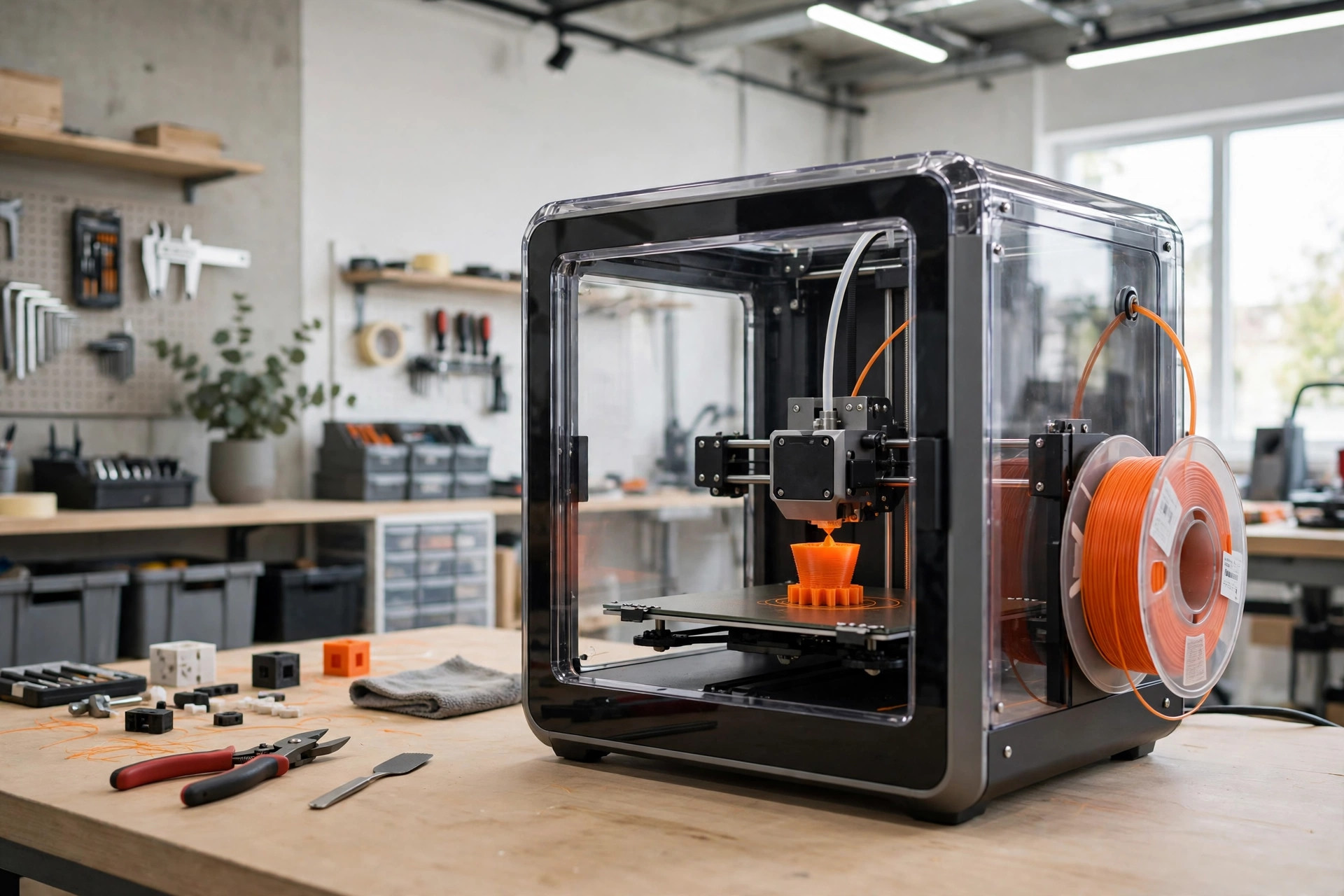
What is 3D printing? In simple terms, it is a way of making a physical object by building it up one thin layer at a time from a digital design. Instead of cutting material away from a larger block, a 3D printer adds material only where it is needed, following instructions from a computer file. That simple idea has changed how prototypes, spare parts, medical devices, toys, and even houses are made.
This guide explains what 3D printing is in plain language, how the process works, the main types of printer, the materials they use, and what the technology is good for, along with its limits. It is very different from putting ink on paper: how digital printing puts ink on paper is a flat, two-dimensional process, while a 3D printer builds a solid object in three dimensions.
What Is 3D Printing?
3D printing, also known as additive manufacturing, creates a three-dimensional object from a digital model. The printer reads a computer file, slices it into hundreds or thousands of very thin horizontal layers, and then deposits, cures, or fuses material layer by layer until the object is complete. Each layer is usually between 0.05 and 0.3 millimetres thick, so fine that the layers are barely visible on a well-printed part.
The key difference from older manufacturing is that material is added rather than removed. A sculptor chips stone away to reveal a shape, and a factory machine mills metal away from a block. A 3D printer does the opposite: it starts with nothing and adds material only where the design needs it. That means less waste, and it makes shapes possible that would be expensive or impossible to machine, such as hollow parts and complex curves.
Unlike the presses used for books and brochures, where traditional offset printing presses transfer ink onto flat sheets, a 3D printer works in volume. It does not print on a surface; it prints the object itself. That is why the same technology is used for everything from a replacement gear for a washing machine to a custom-fitted prosthetic limb.
How Does 3D Printing Work?
Although different printers use different materials, almost all follow the same basic sequence.
1. Create or download a 3D model
Everything starts with a digital model, usually saved as an STL or 3MF file. You can design one yourself in software such as Tinkercad, Fusion 360, or Blender, download a ready-made design from a model library, or scan a real object with a 3D scanner.
2. Slice the model into layers
Slicing software cuts the model into thin horizontal layers, works out the path the printer head should follow, and adds support structures for overhanging parts. The result is a set of instructions, usually in a format called G-code, that tells the printer where to go and how much material to lay down.
3. Set up the printer and material
Before printing, the build plate is levelled and the material is loaded. That might be a spool of plastic filament, a vat of liquid resin, or a bed of fine powder, depending on the printer. A poorly levelled plate is one of the most common reasons a print fails.
4. Print layer by layer
The printer builds the object one layer at a time. A nozzle may melt plastic and lay it down in lines, a light may cure liquid resin, or a laser may fuse powder together. The process is slow compared with factory moulding: a small object can take an hour, and a large one can take a day or more.
5. Remove supports and finish the part
Once printing is done, the part is removed from the build plate, supports are snapped or dissolved away, and the surface is cleaned up. Finishing can include sanding, painting, or curing the part under ultraviolet light to harden it fully.
The Main Types of 3D Printing
FDM (fused deposition modelling) is the most common type, and the one most home printers use. A spool of plastic filament is fed through a heated nozzle, melted, and laid down in lines to build each layer. FDM printers are affordable and good for prototypes and hobby projects, though the layer lines are often visible.
SLA (stereolithography) uses a vat of liquid resin hardened, layer by layer, by a laser or by ultraviolet light. SLA printers produce very smooth, highly detailed parts, which makes them popular for jewellery, dental models, and miniatures. The resin can be messy to handle, and finished parts are usually more brittle than FDM prints.
SLS (selective laser sintering) uses a laser to fuse powdered material, usually nylon, into a solid object. Because the unfused powder supports the part as it is built, SLS needs no support structures, and it can produce strong, functional parts with complex shapes. These machines are expensive and mostly found in professional workshops.
What Materials Can You Print With?
Plastics are the most common materials. PLA is the easiest for beginners: it is made from plant starch, prints at low temperatures, and gives off little smell. ABS is tougher and more heat-resistant, which suits functional parts, but it needs a hotter printer and good ventilation. PETG sits between the two, combining strength with ease of printing, and flexible materials such as TPU can make phone cases and gaskets.
The material affects strength, flexibility, heat resistance, appearance, and cost. A decorative model can be printed in cheap PLA, while a bracket that must hold weight in a hot car needs something tougher, such as PETG or nylon. If you order a printed part, ask the supplier which material suits the job, and think about choosing between glass and plastic packaging for storing and shipping the finished item safely.
What Is 3D Printing Used For?
Prototyping is the most common use. Designers can print a prototype overnight, test it, change the design, and print again, instead of waiting weeks for a factory-made sample. This rapid cycle has made product development faster and cheaper across industries from consumer electronics to car manufacturing.
In medicine, 3D printing makes custom prosthetics, dental aligners, hearing aids, and surgical guides, each fitted to one patient. Manufacturers use it for spare parts and low-volume production, printing a replacement part on demand instead of warehousing thousands of spares.
For many makers, 3D printing has also become a small business. People sell printed planters, board-game accessories, and custom gifts online, and learning how to price your products for profit is just as important as learning to print well, because filament, electricity, and failed prints all cost money.
Advantages and Disadvantages of 3D Printing
Advantages
Complex shapes are easy. Hollow parts and internal channels that are hard to machine can be printed directly, with no moulds or tooling, so one-offs and custom items are affordable. A design can go from screen to a physical object in hours, material is added only where needed so there is less waste, and every copy can be different at no extra cost.
Disadvantages
Slow for large quantities. Printing one part may take hours, so it cannot compete with injection moulding for thousands of identical items. Most affordable printers can only make objects that fit on their build plate, layer lines are often visible, and printed plastics are often weaker than moulded or machined parts.
How Much Does 3D Printing Cost?
A basic home FDM printer costs roughly 200 to 500 dollars, and filament costs around 20 to 30 dollars per kilogram. A small printed object might use a few dollars of material, while a large one can use much more. Resin costs roughly 30 to 60 dollars per litre.
How to Get Started With 3D Printing
Start with an affordable FDM printer and a spool of PLA filament, the most forgiving material for beginners. Download a simple model, slice it with the free software that comes with your printer, and print it. Expect your first few prints to fail: levelling the bed, setting the temperature, and choosing the right speed all take practice.
If you plan to sell what you make, treat it like a real business from the start. Work out your costs, including failed prints and your time, and focus on getting your first customers through local markets and online shops, where a well-made, genuinely useful product will do more for you than a large catalogue of random prints.
Frequently Asked Questions
What is 3D printing in simple terms?
3D printing is a way of making a physical object by building it up one thin layer at a time from a digital design. A printer follows a computer file and adds material, such as melted plastic or cured resin, layer by layer until the object is complete. It is also called additive manufacturing because material is added rather than cut away.
How long does 3D printing take?
It depends on the size and detail of the object. A small, simple item may take 30 minutes to an hour, while a large or detailed object can take 10 hours or more. Layer height, material volume, and printer speed all affect the time.
What is the best 3D printer for beginners?
For most beginners, an affordable FDM printer using PLA filament is the best starting point. FDM printers are cheaper, the materials are easy to handle, and there is a large community offering help. Resin printers give finer detail, but the liquid resin is messier to handle.
Is 3D printing expensive?
Starting out is relatively affordable: a basic home printer costs a few hundred dollars, and filament costs around 20 to 30 dollars per kilogram. The real costs are your time, failed prints while you learn, and finishing work. For occasional parts, ordering from a printing service is usually cheaper than buying your own machine.
What can you not 3D print?
3D printing struggles with very large objects, parts that must bear heavy loads, and items that need a perfectly smooth finish straight off the printer. Some materials need expensive industrial machines, and printed parts are generally weaker than moulded parts.
More Articles You’ll Like
Keep reading — more from this category and across the site:
- What Is Large Format Printing? A Beginner’s Guide
- What Does ‘No Cap’ Mean? Meaning, Origin, and Examples
- How to Package Baked Goods for Shipping Without Breaking Them
- How to Find Obituaries in Madison, AL: A Step-by-Step Guide
- How to Build a Bedtime Routine That Helps You Sleep Better
- What Does ‘Ephemeral’ Mean? Meaning, Origin, and Examples
- 50 Funny Road Trip Jokes for Kids and Adults