Starting to exercise is easy; sticking with it is the hard part. Most beginners quit not because they lack willpower, but because they have no plan: they do too much on day one, feel sore and discouraged, and never go back. Learning how to build a workout routine for beginners is really about starting small and letting your body adapt at its own pace.
A good beginner routine needs no gym membership, fancy equipment, or hour a day — just a clear schedule, a few simple exercises, and gradual progress. It is one of the 10 healthy lifestyle habits for a better life that pays off quietly over weeks and months.
Why a Routine Beats Random Workouts
Random workouts are better than none, but they make progress hard to see. On a schedule, you know exactly what you did last time, so you know what to do next — a simple feedback loop that turns exercise from a chore into a habit.
A routine also removes daily decision-making: you already decided what to do, so you just start. That matters on busy days, when every extra decision is a reason to skip.
Finally, a routine protects you from doing too much. Beginners often feel they should train every day or copy an intense workout they saw online, but rest is built in on purpose — it is when your body gets stronger. Steady movement is also one of the 15 simple ways to reduce stress every day.
Before You Start: Set Yourself Up to Succeed
Pick a goal you can measure
“Get fit” is too vague to guide a routine. Pick something specific, such as “walk for 20 minutes three times a week” or “exercise for 30 minutes on Mondays, Wednesdays, and Fridays.” A clear goal tells you whether your routine is working and gives you something to celebrate when you reach it.
Choose your time and place
Decide in advance when and where you will work out. Mornings work well for many people because the day has not yet filled up, and a short session first thing sets the tone for the day. If mornings suit you, our guide on how to start a morning routine that actually works shows how to fit exercise into the first hour without rushing.
If mornings are not realistic, pick another fixed slot — lunch break, after work, or early evening — and stick to it. Home workouts need almost no space, and a park or gym works too, as long as getting there is easy.
Talk to a doctor if you need to
Most healthy adults can start gentle exercise safely, but if you have a medical condition, an old injury, chest pain, or dizziness, or you have been inactive for a long time, check with a doctor first — especially if you take medication that affects your heart rate or blood pressure.
Choose Exercises You Can Actually Do
A beginner routine should cover the whole body with a small number of movements — five or six well-chosen ones are enough.
Here is a simple starter set, all doable at home with no equipment:
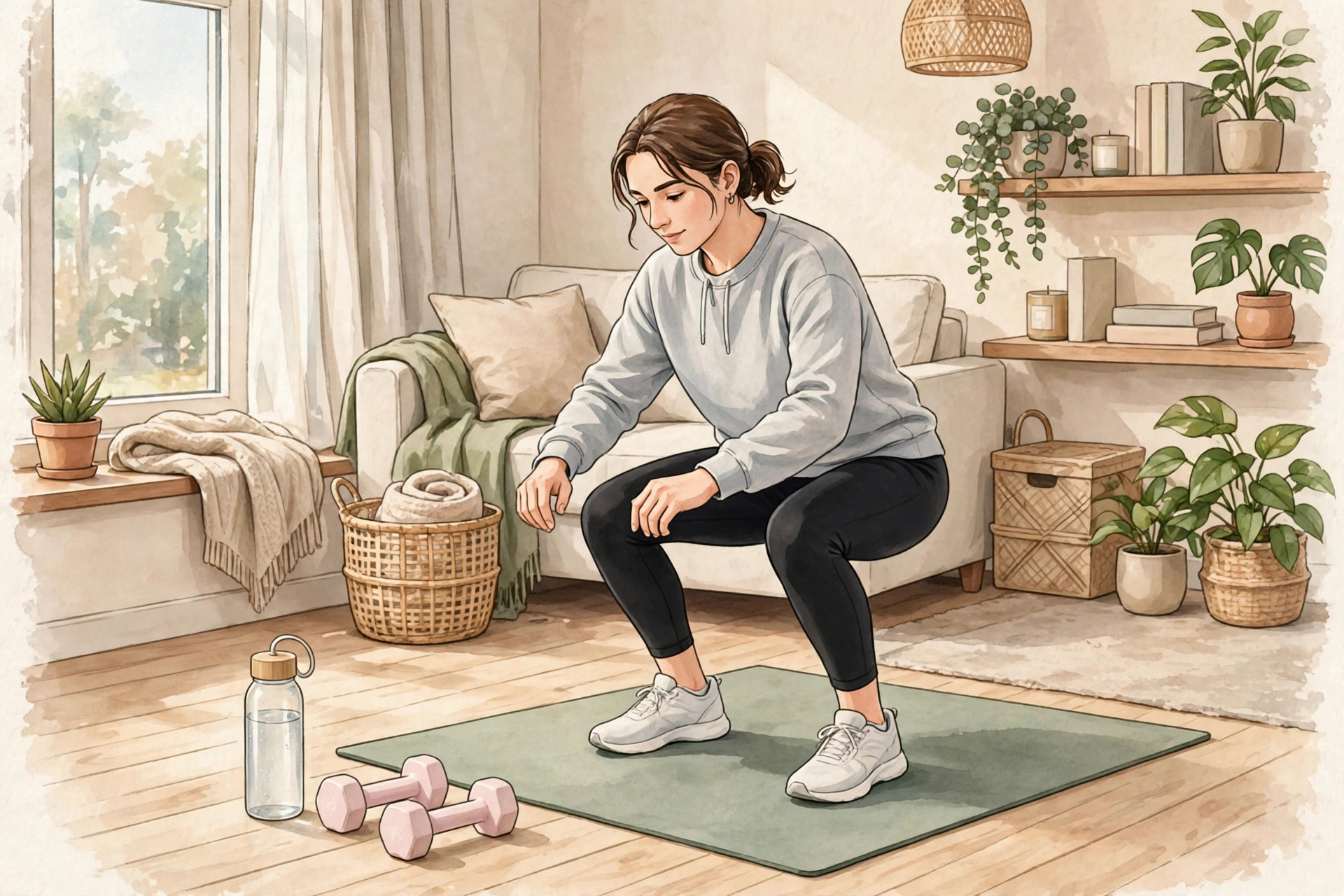
- Squat to a chair: lower yourself to lightly touch a chair seat, then stand. Builds leg strength and balance.
- Wall or knee push-up: from your knees, or standing against a wall, build upper-body strength without straining your shoulders.
- Glute bridge: lying on your back with knees bent, lift your hips to strengthen the muscles supporting your lower back.
- Bird dog: on hands and knees, extend one arm and the opposite leg, then switch, to build core stability.
- Standing row with a resistance band or water bottles: pull your elbows back to strengthen your upper back.
- Marching in place: lift your knees one at a time for gentle cardio that also works your legs and balance.
Start with 2 sets of 8 to 10 repetitions of each, resting about a minute between sets. The last couple should feel challenging but doable with good form — quality matters far more than quantity.
Walking counts too: a brisk 20 to 30 minute walk is real exercise and a great starting point after a long inactive stretch. Build your first routine around it and add strength exercises as you get comfortable.
Build Your Weekly Schedule
For most beginners, three sessions a week is the sweet spot: enough to progress, with rest days in between. Here is a sample week to copy:
- Monday: full-body strength (the six exercises above), 20 to 30 minutes.
- Tuesday: rest or a gentle 20-minute walk.
- Wednesday: full-body strength, 20 to 30 minutes.
- Thursday: rest or a gentle walk.
- Friday: full-body strength, 20 to 30 minutes.
- Saturday: a longer walk, bike ride, or activity you enjoy, 30 to 45 minutes.
- Sunday: rest.
Keep the same days each week so the routine becomes automatic, and put sessions in your calendar like appointments. If you miss one, do not double the next — just do the next scheduled session.
Always Warm Up and Cool Down
A warm-up prepares your muscles and joints and lowers the chance of strains. Spend five minutes on gentle movement before every session: march in place, swing your arms, roll your shoulders, and do a few slow squats. You should feel warmer and looser, not tired.
Cooling down is just as simple: walk slowly for a few minutes, then stretch the muscles you used — calves, thighs, chest, shoulders — holding each stretch for 20 to 30 seconds without bouncing. It should feel like a mild pull, never pain.
Skipping the warm-up is the most common beginner mistake, and the easiest to fix: five minutes at the start saves you soreness and setbacks later.
How to Progress Safely
Progress keeps a routine interesting, but it must be gradual: your body adapts to a small challenge, then you add a slightly bigger one. Change only one thing at a time — more repetitions, a longer walk, or a slightly harder exercise version — never all three at once.
Here is a simple four-week progression: week one, 2 sets of 8; week two, 2 sets of 10; week three, add a third set; week four, try a harder variation, such as knee push-ups instead of wall push-ups. If a step feels too hard, stay at your current level another week.
Listen to your body. Soreness for a day or two after a new exercise is normal in the first weeks, but sharp pain, joint pain, or pain that worsens during an exercise is not — stop that exercise and, if the pain persists, talk to a doctor or a qualified trainer.
Rest and Recovery Matter as Much as Exercise
Your muscles get stronger while you recover, not while you exercise, as your body repairs the small stress the workout caused. That is why rest days are part of the routine, not a break from it.
Sleep is the biggest part of recovery: most adults need seven to nine hours a night, and regular exercise can make falling asleep easier — as long as you are not training hard right before bed. If sleep is a struggle, our guide on how to build a bedtime routine that helps you sleep better can help you wind down on training days.
On rest days, gentle movement still helps — a walk, light stretching, or chores keep you moving without strain. Eat regularly, drink water, and take at least one full rest day each week. A routine you can sustain for a year beats one that burns you out in a month.
Track Your Progress (and Keep It Simple)
Tracking turns vague effort into visible progress — one of the strongest motivators there is. After each session, write down what you did: the exercises, sets, repetitions, and how it felt. A notebook, notes app, or spreadsheet all work.
If you enjoy writing things down, how to start journaling for beginners offers a simple five-minute approach you can adapt to a workout log: a few lines after each session about what went well and what felt hard. Over a month, those notes show exactly how far you have come.
Review your log weekly — which exercises are getting easier, which days you skip — and use what you see to adjust next week, not to judge yourself. Flat weeks are normal too.
A Simple 4-Week Starter Plan
Put it together and your first month looks like this: same three strength days and six exercises each week, with only the small change listed.
- Week 1: 2 sets of 8 repetitions per exercise; walk 20 minutes on two rest days; focus on learning the movements.
- Week 2: 2 sets of 10 repetitions; add five minutes to your walks.
- Week 3: 3 sets of 10 repetitions; try a harder variation of your easiest exercise.
- Week 4: 3 sets of 10 to 12 repetitions; take stock of what feels easier and what to work on next month.
After four weeks you will know your body, schedule, and preferences far better than any article can tell you. From there, add new exercises, try a class, or gradually move to four sessions a week.
Frequently Asked Questions
How many days a week should a beginner work out?
Three days a week is a good starting point — enough training to progress and enough rest to recover. Add a fourth day after a month or two, once three days feels comfortable.
How long should a beginner workout last?
About 20 to 30 minutes, including a five-minute warm-up and a short cool-down, is plenty. Short sessions are easier to fit into a busy day and easier to repeat.
Do I need a gym or equipment to start?
No. Bodyweight exercises at home — squats, push-ups, glute bridges, and marching — are enough for your first weeks. A resistance band or light dumbbells are a cheap next step if you want more challenge; a gym is optional.
How sore should I expect to be?
Some soreness for one to two days after your first few sessions is normal and should fade as your body adapts. Sharp or joint pain, or soreness lasting more than three or four days, is a sign to ease off and, if it continues, talk to a doctor.
When will I start seeing results?
Most beginners notice better energy, mood, and sleep within two to three weeks, and strength gains within four to six weeks. Visible body changes usually take eight to twelve weeks of steady training.
More Articles You’ll Like
Keep reading — more from this category and across the site:
- How to Declutter Your Home in a Weekend: A Room-by-Room Guide
- How to Practice Self-Care on a Busy Schedule
- 50 Funny Hot Chocolate Jokes for Kids and Adults
- How to Choose the Right Packaging Materials for Your Product
- How to Create a Business Budget: A Step-by-Step Guide
- How to Find Obituaries in Athens, AL: A Step-by-Step Guide
- How to Fix Common Printing Problems: A Troubleshooting Guide
- What Does ‘Limerence’ Mean? Meaning, Origin, and Examples
- What Does ‘Lowkey’ Mean? Meaning, Origin, and Examples