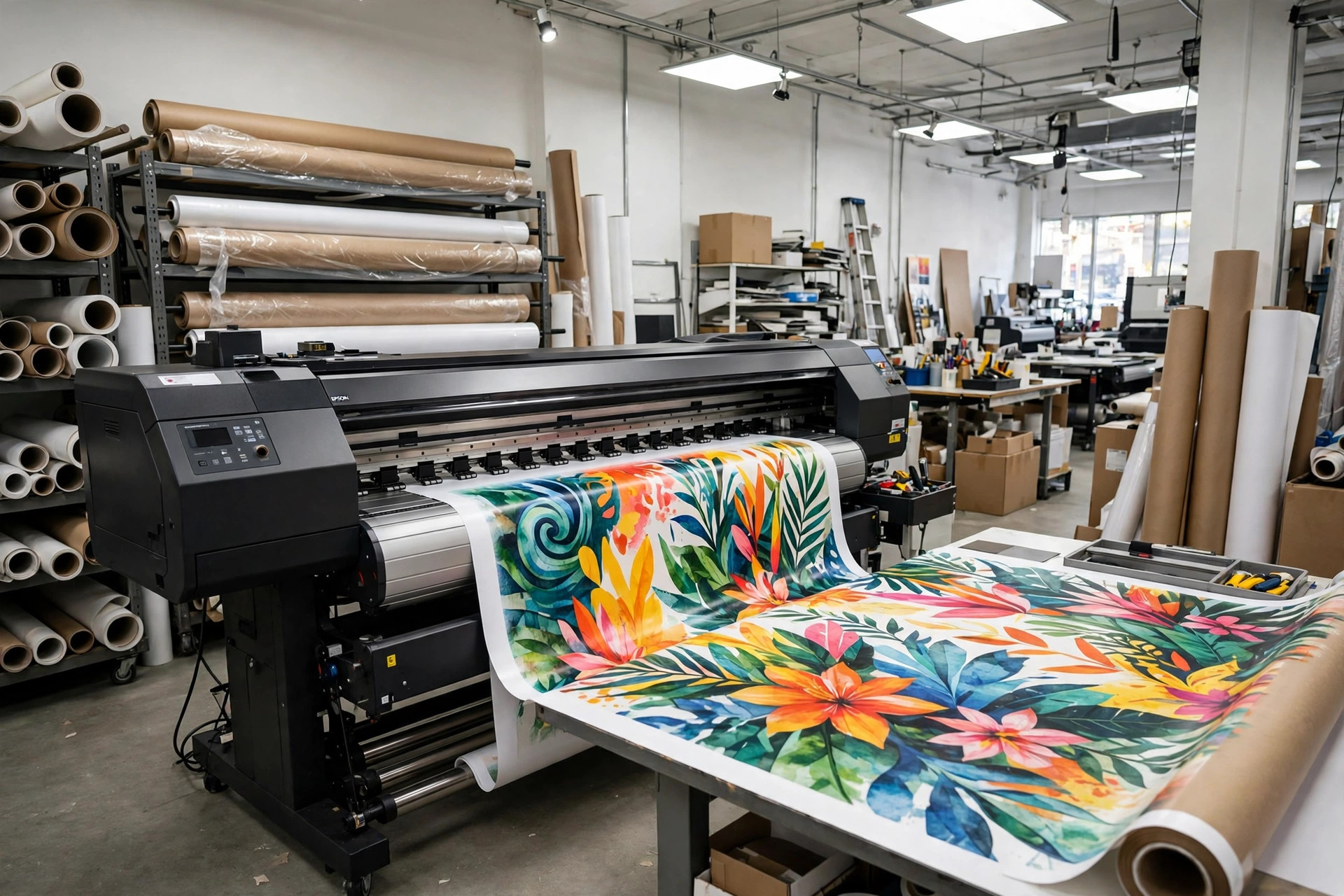
What is large format printing? It is printing on a much bigger scale than the documents that come out of an office printer. While a standard printer handles sheets up to A4 or A3 size, a large format printer produces posters, banners, signs, trade-show graphics, wallpaper, vehicle wraps, and exhibition displays, often several feet wide. If you have ever walked past a shop window, a billboard, or a banner at a sports event, you have seen large format printing at work.
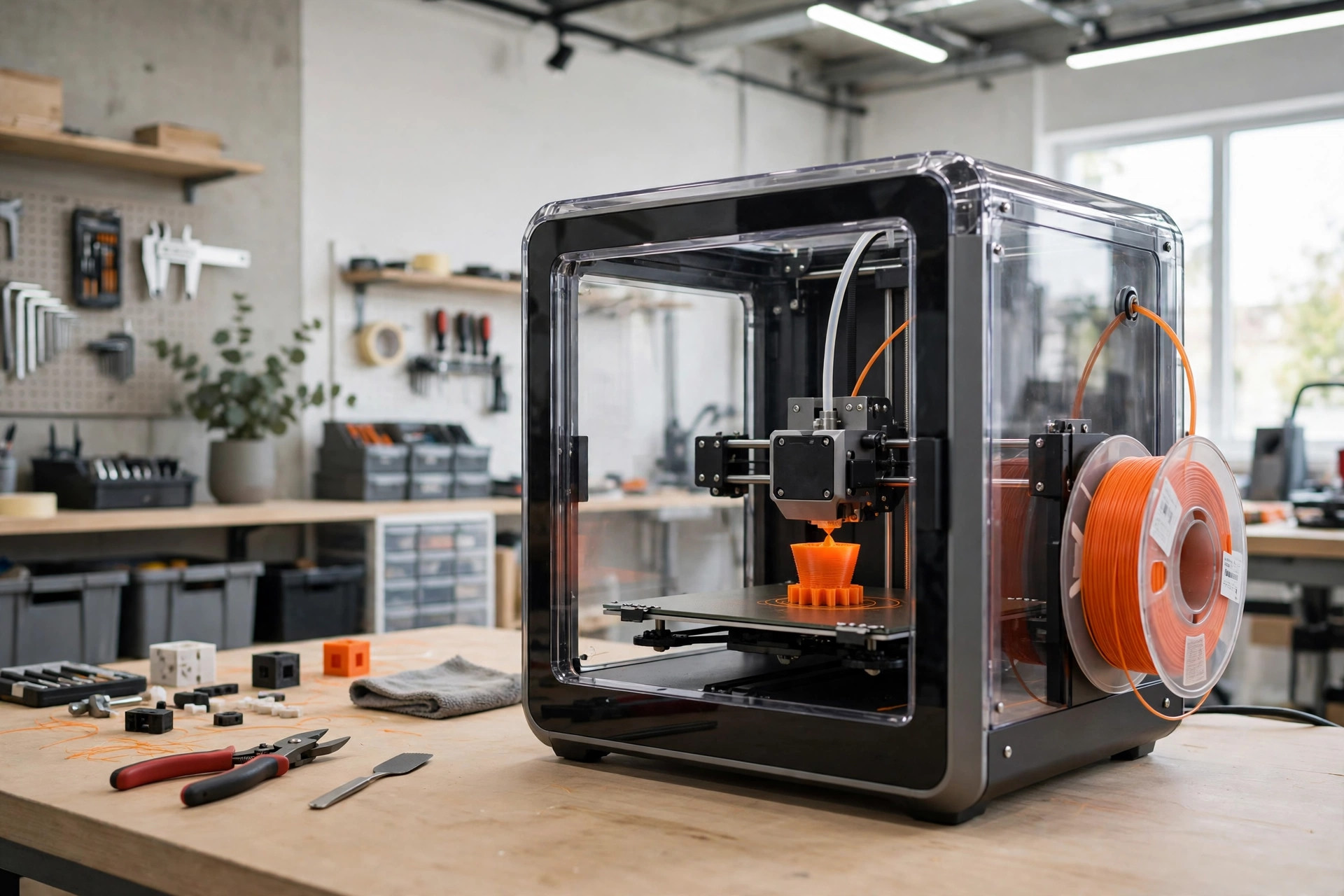
This beginner’s guide explains what large format printing is, how it works, the materials and printers involved, what it costs, and when it is the right choice for your project. Unlike how 3D printing builds objects layer by layer, large format printing is a flat process: ink is laid down on a wide roll or sheet of material to create a single large image. By the end, you will know what to ask a print shop for and how to prepare your artwork.
What Is Large Format Printing?
Large format printing, also called wide format printing, is any printing that produces items larger than the standard sizes handled by office printers. As a rough rule, it starts at around 18 inches (about 46 centimetres) wide and goes up from there. Common products include posters, pull-up banners, shop signs, window graphics, billboards, floor graphics, canvas prints, and exhibition backdrops.
The printers are large machines that feed wide rolls of material, sometimes up to 5 metres wide, through the print area. They use inkjet technology in most cases, spraying tiny droplets of ink with great precision, and they can print on far more than paper, including vinyl, fabric, canvas, and rigid boards.
Large format printing is different from the printing used for books and leaflets. For small, flat pages in high volumes, traditional offset printing is usually the better choice, because it is cheaper per copy on long runs. Large format printing fills the gap where offset cannot go: one-off prints, very large sizes, and unusual materials.
How Does Large Format Printing Work?
Most large format printing uses inkjet technology, though the details vary by machine and material. The basic process is straightforward, and understanding it helps you prepare better files.
1. Your artwork is prepared at large size
Your design is created or scaled to its final printed size. Because the finished piece will be viewed from a distance, the resolution needed is lower than for a magazine page: around 100 to 150 dots per inch at full size is usually enough for a banner, while a poster viewed up close may need more.
2. Ink is applied in passes
The print heads move back and forth across the material, laying down tiny droplets of ink in several passes. Most printers use CMYK inks, and many add light cyan, light magenta, or white for a wider range of tones. UV inks are hardened instantly by ultraviolet light, while solvent and latex inks dry by evaporation and heat.
3. The print is dried and finished
After printing, the material is dried or cured, then trimmed, and often laminated for protection. Finishing can include hemming the edges of a banner, adding eyelets for hanging, mounting a print on a rigid board, or applying a protective film that guards against sunlight and scratches.
Types of Large Format Printers
Solvent and eco-solvent printers are the workhorses of the sign industry. They print on vinyl and other flexible materials, and the finished prints are durable outdoors for several years. Eco-solvent inks produce less odour than older solvent inks.
Latex printers use water-based inks cured with heat. They produce prints with little smell, which makes them a good choice for indoor displays, hospitals, and schools, and the prints are scratch-resistant.
UV flatbed printers print directly onto rigid materials such as wood, glass, metal, and acrylic. The ink is cured instantly with ultraviolet light, so the print is dry and durable the moment it leaves the machine. These printers are ideal for signs and panels that need to look sharp and last.
What Materials Can You Print On?
One of the strengths of large format printing is the range of materials it handles. Vinyl is the most common, used for banners, vehicle wraps, window stickers, and outdoor signs because it is tough, waterproof, and flexible. Paper is used for posters and short-term displays, while canvas gives art prints a traditional texture.
Fabric is popular for exhibition graphics and flags because it is lightweight, folds for transport, and does not crease as easily as vinyl. Rigid materials include foam board, corrugated plastic, acrylic, and aluminium composite panels, used for shop signs and durable outdoor displays. There are also specialist materials such as backlit film for light boxes, floor vinyl that can be walked on, and wallpaper printed to order.
What Is Large Format Printing Used For?
Advertising is the biggest use. Shop signs, window displays, billboards, vehicle wraps, and point-of-sale posters all come from large format printers. A well-printed sign can be seen from across the street, which is why businesses invest in it: it works around the clock, in all weathers.
Events and exhibitions rely on it heavily. Pull-up banners, exhibition stands, backdrops, and wayfinding signs are usually large format prints. Because most of these items are needed in small numbers and on short notice, short-run digital printing methods suit them well, with no plates to make and no minimum order to meet.
How Much Does Large Format Printing Cost?
Large format printing is usually priced by area, material, and finishing, so a poster and a vehicle wrap can cost very different amounts. As a rough guide, a standard A1 poster on paper may cost a few dollars, while a large vinyl banner of several square metres can cost tens or hundreds of dollars, depending on material, hemming, eyelets, and lamination.
Several things affect the price. The material is usually the biggest factor: basic paper is cheap, while specialist vinyl, canvas, or rigid board costs more. Lamination adds to the cost but protects the print and extends its life outdoors. Design work is often charged separately, so supplying a print-ready file can save you money.
To get a fair quote, tell the printer the finished size, the material, where the print will be used, and how long it needs to last. Ask whether the price includes finishing and delivery, and ask for a proof before a large job is printed. If you run a print business, learning pricing your large format work for profit is essential, because material, ink, machine time, and finishing all add up, and undercharging is the most common mistake new print shops make.
How to Prepare Your Files for Large Format Printing
Good files are the difference between a sharp, professional print and a blurry disappointment. Follow these basics before sending artwork to a print shop.
Design at the right size. Set your document to the final printed size, or to a clean scale such as half size, and tell the printer the scale you used. Designing at a tiny size and asking the printer to enlarge it will make the image soft and blurry.
Use the right resolution. Images should be 100 to 150 dots per inch at full size for banners viewed from a distance, and higher for pieces viewed up close. Vector graphics, such as logos and text, are best because they stay sharp at any size.
Work in CMYK. Large format printers use CMYK inks, so design in CMYK rather than RGB, the colour mode used for screens. Bright screen colours may not reproduce exactly, so ask for a proof if colour accuracy matters.
Send a print-ready PDF. Most print shops prefer a high-quality PDF with fonts embedded or converted to outlines. Include a small preview image so the printer can check the design at a glance, and ask for a printed proof on large or expensive jobs.
Large Format Printing vs Other Printing Methods
Large format printing is not the right choice for every job, and knowing when to use something else saves money. For thousands of identical leaflets or brochures, offset printing is cheaper per copy and faster overall. For a single custom T-shirt or mug, a specialist process such as screen printing or sublimation is better.
If you are thinking of offering large format printing as a service, it is a realistic small business to build around a single machine and a good local market. Many print shops started with one wide format printer and a few regular customers, and starting a small printing business follows the same practical steps as any other service business: learn the craft, find customers who need signs and displays, and deliver reliably on time.
Frequently Asked Questions
What is large format printing in simple terms?
Large format printing is printing on a much bigger scale than an office printer can handle. It produces posters, banners, signs, and displays, often several feet wide, using wide printers that feed large rolls or sheets of material. It is also called wide format printing, and it is the method behind most of the big printed graphics you see in shops, at events, and on the street.
How big can large format printing go?
Most large format printers handle widths from around 18 inches up to 5 metres, and the length is limited mainly by the roll of material. Very large images, such as billboards and building wraps, are printed in panels and joined together on site. Your print shop can advise on the maximum size for your chosen material.
How long do large format prints last outdoors?
It depends on the material, ink, and finishing. A vinyl banner printed with solvent or latex inks and laminated can last three to five years outdoors, while an unlaminated paper poster may fade within weeks. UV light, rain, and wind all shorten the life of a print.
What resolution do I need for large format printing?
For banners and posters viewed from a distance, 100 to 150 dots per inch at full size is usually enough, because the viewer is far away. For prints viewed up close, aim higher, around 200 to 300 dots per inch. Vector logos and text stay sharp at any size.
Is large format printing expensive?
It depends on size, material, and finishing. A small poster on paper is inexpensive, while a large laminated vinyl banner or a vehicle wrap costs considerably more. Prices are usually charged by area, so getting an accurate quote means telling the printer the finished size, the material, and where the print will be used.
More Articles You’ll Like
Keep reading — more from this category and across the site:
- What Does ‘No Cap’ Mean? Meaning, Origin, and Examples
- How to Package Baked Goods for Shipping Without Breaking Them
- How to Find Obituaries in Madison, AL: A Step-by-Step Guide
- How to Get Your First Customers: 10 Practical Ways
- How to Build a Bedtime Routine That Helps You Sleep Better
- What Does ‘Ephemeral’ Mean? Meaning, Origin, and Examples
- 50 Funny Road Trip Jokes for Kids and Adults