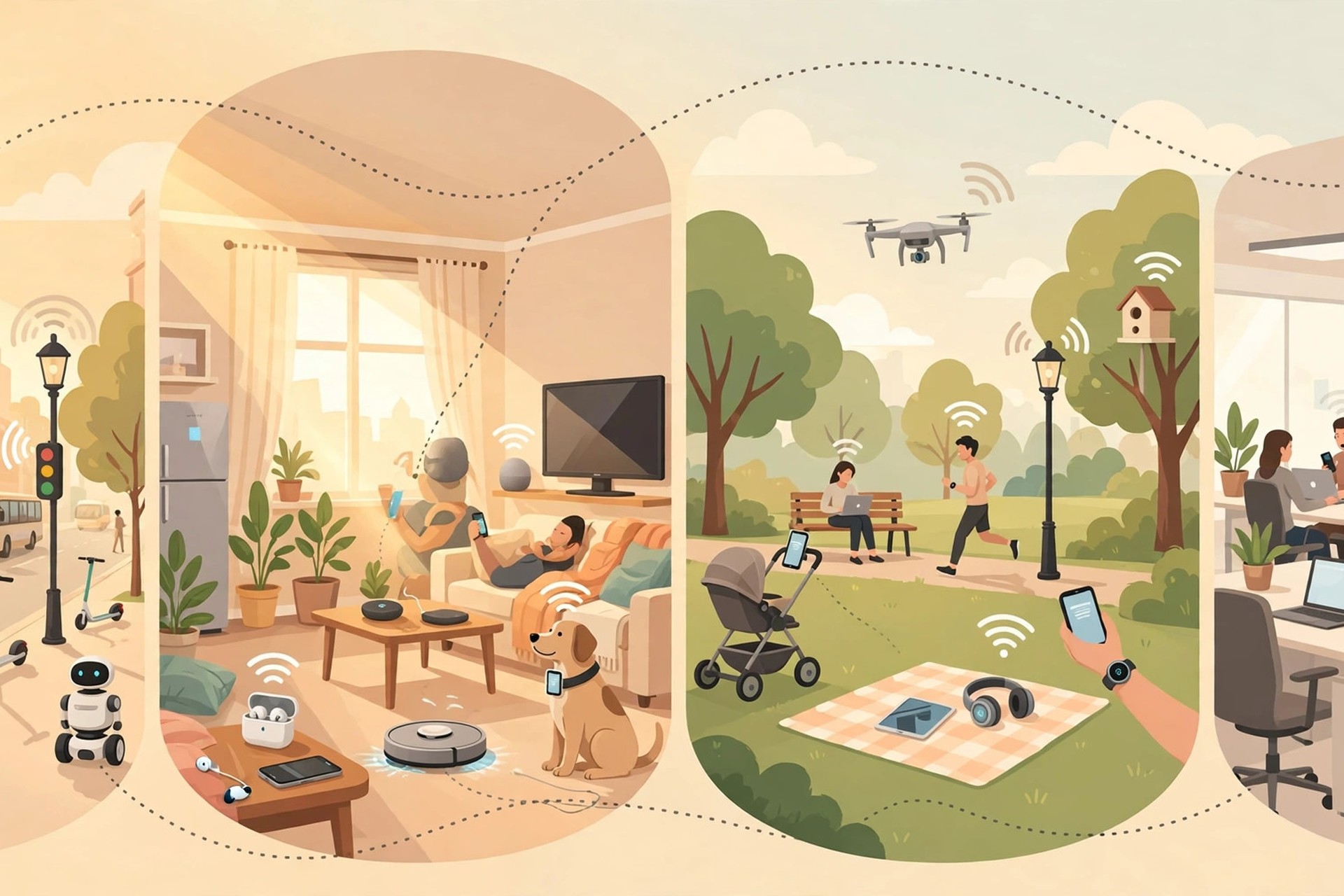
Open your phone and you will see it. Walk down a high street and you will see it. Turn on the television, sit in a cafe, or glance at the billboards on your commute — it is there too. Some things are so common that they seem to be everywhere at once, and English has a single elegant word for that quality. If you have ever wondered what does ubiquitous mean, it describes something that is present everywhere, all at the same time. In this guide, you will learn the full meaning of ubiquitous, where it comes from, how to pronounce it, and how to use it naturally in your own writing and conversation.
What Does Ubiquitous Mean?
Ubiquitous is an adjective meaning present everywhere at the same time, or seeming to be everywhere. If something is ubiquitous, you cannot go far without running into it. Smartphones are ubiquitous. Advertising is ubiquitous. In many cities, coffee shops feel ubiquitous, with one on nearly every corner.
The word carries a sense of more than simple commonness. Something merely common shows up often; something ubiquitous seems to surround you. It suggests a presence so widespread that avoiding it takes effort. That is why the word is often used for technology, trends, brands, and ideas that spread until they feel like part of the background of daily life.
Nature offers its own examples. After rain, the smell of wet earth seems to hang in the air everywhere you walk, and that scent has its own name — learning what petrichor means is a good reminder that even the natural world has precise words for things that seem to be all around us at once.
The Origin of Ubiquitous
Ubiquitous comes from the Latin word ubique, meaning “everywhere.” Ubique itself is formed from ubi, meaning “where,” and -que, meaning “and” or “also” — so the literal sense is something like “where and where,” or “everywhere at once.” The Latin noun ubiquitas meant “the state of being everywhere,” and English borrowed it in the 16th century, first in theological writing about God being present everywhere.
For a long time, ubiquitous was mostly a church word. Theologians used it to describe the divine presence: God, being ubiquitous, was everywhere at once. Over the centuries, the word gradually moved out of theology and into everyday language, keeping its core meaning but losing its religious weight. By the 19th and 20th centuries, writers were using it for anything widespread — from fog to fashion to fame.
Today, ubiquitous is a favourite of technology writers, who describe smartphones, Wi-Fi, social media, and artificial intelligence as ubiquitous — shorthand for how modern technology has woven itself into every part of life.
How to Pronounce Ubiquitous
Ubiquitous is pronounced yoo-BIK-wi-tus, with the stress on the second syllable. It has four syllables: u-biq-ui-tous, roughly “yoo-BIK-wih-tuss.” The first syllable sounds like “you,” the second carries the emphasis, and the final syllables are quick and soft.
The related noun is ubiquity, pronounced yoo-BIK-wi-tee, meaning the state of being everywhere at once — as in “the ubiquity of smartphones.” You may also come across the adverb ubiquitously, though it is much rarer. Most of the time, the adjective is the form you need.
One common mistake is to stress the first syllable, saying “OO-bi-kwi-tus.” Practise the word slowly — yoo-BIK-wi-tus — and it quickly becomes natural to say.
Ubiquitous vs Omnipresent, Everywhere, and Pervasive
Ubiquitous has several close neighbours, and choosing between them is mostly a matter of tone and precision.
There is also a lighter, more playful side to the word. When we call something ubiquitous, we are often half-joking about how impossible it has become to escape — the song playing in every shop, the phrase everyone suddenly uses, the logo on every jacket. A chance encounter with something everywhere can even feel like what serendipity means in reverse: instead of a happy accident you stumble across once, it is a familiar thing you keep bumping into wherever you go.
Ubiquitous vs Omnipresent
Omnipresent is the more formal and more absolute of the two. It means present everywhere at all times, and it is still used mainly for God or for a divine presence. Ubiquitous is the everyday version: it means seeming to be everywhere, and it works for phones, logos, songs, and trends. If you are writing about religion or philosophy, omnipresent may fit; for anything else, ubiquitous is usually the better choice.
Ubiquitous vs Everywhere
“Everywhere” is the plain, everyday word, and it is often all you need. “Phones are everywhere” is clear and simple. Ubiquitous adds a layer of emphasis and elegance: it suggests not just that something is in many places, but that its presence is striking, even overwhelming. Use “everywhere” in casual conversation and ubiquitous when you want the sentence to carry a little more weight.
Ubiquitous vs Pervasive
Pervasive means something that spreads through everything, often in a way that is hard to notice — a pervasive smell, a pervasive sense of unease, pervasive corruption. Ubiquitous is about being seen everywhere; pervasive is about spreading through something. A smell can be pervasive without being visible, and a brand can be ubiquitous without spreading through anything. The two words overlap when something is both everywhere and hard to escape, but they are not interchangeable.
How to Use Ubiquitous in a Sentence
Because ubiquitous is a fairly formal word, it works best where a slightly elevated tone fits: essays, articles, speeches, and thoughtful discussion. Used well, it makes a sentence sharper — but save it for things that really do seem to be everywhere.
A good rule is to pair ubiquitous with a concrete example. Instead of writing “advertising is ubiquitous,” write “advertising is ubiquitous — it follows you from the bus stop to your phone screen to the video you are trying to watch.” The detail proves the claim, and the word does the work of tying it together. The same trick works for light itself: a bright sign or a glowing screen can feel what luminous means — shining and impossible to miss — and ubiquity is often what makes that glow hard to avoid.
Try the word in different sentence positions. It can come before the noun, as in “the ubiquitous smartphone,” or after a linking verb, as in “coffee shops have become ubiquitous.” Both work, and switching between them keeps your writing from sounding repetitive.
Some things are ubiquitous only for a short while, and then they vanish. A fashion trend, a catchphrase, or a viral video can be everywhere for a month and forgotten by the next season. Those brief, bright moments are close to what ephemeral means — lasting a very short time — and the contrast is useful: ubiquitous describes how widely something spreads, while ephemeral describes how briefly it lasts.
Ubiquitous in Everyday Life
Once you know the word, you start noticing ubiquity everywhere — which is fitting. The most obvious example is the smartphone. In less than twenty years, it has gone from a luxury to something carried by nearly every adult, used for banking, maps, messaging, photography, work, and entertainment.
Brands and logos are another example. A famous soft-drink logo, a coffee cup, or a sports brand’s tick can be spotted on streets all over the world, and recognising them in a foreign city feels oddly comforting. Music works the same way: a hit song can be ubiquitous for a summer, playing in shops, cars, and cafes until everyone knows the chorus whether they like it or not.
And then there is the quiet kind of ubiquity that we barely notice. The realisation that every stranger you pass has a life as rich and complicated as your own is one of those ideas that, once learned, seems to be everywhere — and it is captured by what sonder means, a word for the sudden awareness that each person around you is living a story just as vivid as yours.
Example Sentences
Here is how ubiquitous sounds in real sentences:
- Smartphones have become ubiquitous — almost everyone carries one.
- Coffee shops are ubiquitous in this city; there is one on nearly every street.
- By the 2010s, Wi-Fi was ubiquitous in hotels, cafes, and airports.
- The company’s logo is ubiquitous, appearing on billboards, buses, and football shirts.
- Plastic packaging is so ubiquitous that it is hard to shop without encountering it.
- That song was ubiquitous all summer — you could not escape it anywhere.
Why We Love the Word Ubiquitous
Part of the word’s appeal is its sound. Ubiquitous is rhythmic and slightly playful, with a bounce that makes it fun to say — yoo-BIK-wi-tus. It feels clever without feeling stiff, which is why students and writers reach for it so often.
But the deeper appeal is what it lets us name. Ubiquitous turns a vague feeling — “I keep seeing this everywhere” — into a precise observation, and that precision is satisfying.
Frequently Asked Questions
What does ubiquitous mean in simple terms?
In simple terms, ubiquitous means present everywhere at the same time. If something is ubiquitous, you see it wherever you go — like smartphones, advertising, or coffee shops in a big city. It describes things that are so widespread they seem impossible to avoid.
How do you pronounce ubiquitous?
Ubiquitous is pronounced yoo-BIK-wi-tus, with the stress on the second syllable. It has four syllables: u-biq-ui-tous. The related noun is ubiquity, pronounced yoo-BIK-wi-tee, meaning the state of being everywhere at once.
What is the difference between ubiquitous and omnipresent?
Omnipresent means present everywhere at all times and is mainly used in religious or philosophical writing about God. Ubiquitous is the everyday version: it means seeming to be everywhere, and it works for phones, brands, songs, and trends. Omnipresent is absolute; ubiquitous is about striking, widespread presence in ordinary life.
Is ubiquitous a positive or negative word?
Ubiquitous is neutral — it depends on the context. It can be positive, as in the ubiquitous availability of clean drinking water, or negative, as in ubiquitous advertising or ubiquitous plastic waste. Often it carries a slight tone of surprise or exasperation at how hard something is to escape.
What is an example of something ubiquitous?
Classic examples include smartphones, Wi-Fi, social media, advertising, and coffee shops. In nature, sunlight and air are ubiquitous. A song that plays in every shop and on every radio station for a whole summer is another good example of something ubiquitous.
More Articles You’ll Like
Keep reading — more from this category and across the site:
- What Does ‘Ineffable’ Mean? Meaning, Origin, and Examples
- What Does ‘Limerence’ Mean? Meaning, Origin, and Examples
- 50 Funny Hot Chocolate Jokes for Kids and Adults
- How to Build a Workout Routine for Beginners
- How to Choose the Right Packaging Materials for Your Product
- How to Create a Business Budget: A Step-by-Step Guide
- How to Find Obituaries in Athens, AL: A Step-by-Step Guide
- How to Fix Common Printing Problems: A Troubleshooting Guide
- What Does ‘Lowkey’ Mean? Meaning, Origin, and Examples