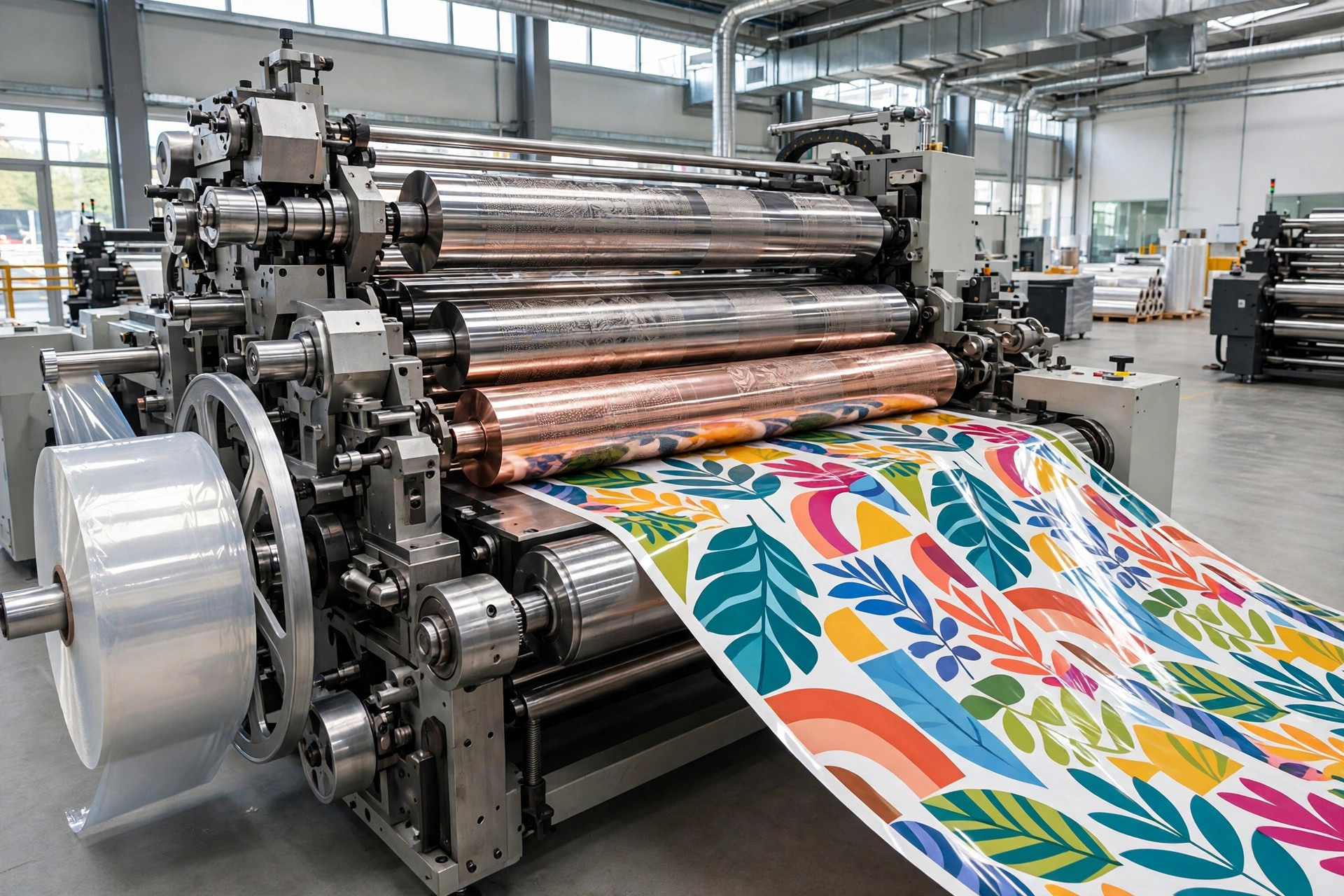
Gravure printing is one of the oldest and fastest ways to print in large quantities. If you have picked up a glossy magazine, a cereal box, a food wrapper, or a roll of wallpaper, you have almost certainly held something printed by gravure. The process uses an engraved metal cylinder to transfer ink onto paper, film, or foil at very high speed, and it produces rich, consistent colour that stays the same from the first copy to the millionth.
Most people never need to know how gravure printing works, until they need to print a lot of something and need it to look perfect every time. That is when the choice between printing methods starts to matter. The comparison in what is offset printing covers the other major high-volume method, and this guide explains how gravure differs and when it is worth the cost.
What Is Gravure Printing?
Gravure printing, also called rotogravure, is a form of intaglio printing. Intaglio means the image is cut into the printing surface rather than raised above it. In gravure, the image is engraved as tiny cells into a copper-plated steel cylinder. Ink fills those cells, a blade wipes the excess ink off the surface, and the cylinder presses the ink onto the material as it rolls past.
Because the image is engraved into solid metal, a gravure cylinder can print millions of copies without wearing out. That durability, combined with very high press speeds, is what makes gravure the standard choice for huge print runs.
The name comes from the French word “graver”, meaning to engrave. The method was developed in the nineteenth century for fine art reproduction, because it could reproduce photographs and paintings with a quality no other method could match. That reputation for quality has stayed with it ever since.
How Gravure Printing Works
The gravure process has four main stages, and each one matters for the final quality.
1. Cylinder Preparation and Engraving
Everything starts with the cylinder. A steel cylinder is coated with copper, and the image is engraved into the copper as millions of tiny cells. The depth of each cell controls how much ink it holds, which is how gravure creates smooth tones and shading: deeper cells hold more ink and print darker, shallower cells hold less and print lighter. Modern cylinders are engraved by laser or by a diamond-tipped stylus controlled by a computer, which gives very precise results.
2. Inking the Cylinder
The cylinder rotates through a tray of liquid ink, and the engraved cells fill with ink. Gravure ink is much thinner and more fluid than the paste-like ink used in offset printing, which is one reason the process runs so fast. Each colour in the design has its own cylinder, so a four-colour job uses four cylinders in sequence.
3. The Doctor Blade
As the cylinder turns, a thin steel blade called a doctor blade scrapes across its surface and removes all the ink except the ink sitting inside the engraved cells. This is a critical step: if the blade leaves too much ink, the print looks muddy, and if it removes too much, the colours look pale. The blade has to be kept sharp and set at exactly the right angle.
4. Printing and Drying
The cylinder presses against the material, which is held tight by a rubber impression roller, and the ink transfers out of the cells onto the surface. The printed material then passes through a hot-air dryer, which evaporates the solvent in the ink in seconds. Because the ink dries so quickly, the material can be printed on the other side, laminated, or cut almost immediately.
What Is Gravure Printing Best For?
Gravure is at its best when you need a very large number of identical copies with excellent, consistent quality:
- Magazines and catalogues: high-circulation glossy magazines are a classic gravure product, because the image quality is superb and the cost per copy falls sharply at large volumes.
- Flexible food packaging: crisp packets, coffee bags, biscuit wrappers, and sweet wrappers are usually printed by gravure on plastic film or foil, because gravure handles thin films well and the ink dries fast enough for the film to be laminated and sealed straight away. If you sell food, our guide on how to label food packaging covers the rules that apply once the pack is printed. away.
- Labels and cartons: large runs of labels, folding cartons, and cigarette packaging.
- Wallpaper and gift wrap: long continuous patterns with rich, even colour.
- Security printing: gravure is used for some banknotes, stamps, and tickets, because the engraved pattern is hard to copy.
If your job is in one of these categories and the run is large, gravure is probably the method your printer will suggest. If the run is small, the setup cost will usually rule it out.
Gravure vs Offset vs Digital Printing
The three main printing methods each suit different jobs. Here is how they compare.
Gravure
Best for very long runs, usually tens or hundreds of thousands of copies and above. Setup is expensive because each colour needs its own engraved cylinder, but the cost per copy is very low once the press is running, and the quality is extremely consistent. Colour reproduction is excellent, especially for photographs and rich, solid colours.
Offset Printing
Best for medium to long runs, from a few thousand copies upwards. Offset uses plates rather than engraved cylinders, so setup is much cheaper than gravure, and the quality is also very high. It is the standard choice for books, brochures, leaflets, and business stationery.
Digital Printing
Best for short runs, from one copy to a few thousand, and for jobs that need variable data, such as personalised names or addresses. There are no plates or cylinders, so setup is almost free and turnaround is fast, but the cost per copy stays high and does not fall with volume. What is digital printing covers when this method makes sense, and the same logic applies to other short-run methods such as the one in what is UV printing, which suits small batches of rigid items like signs and phone cases.
As a rough rule: if you are printing fewer than a few thousand copies, choose digital. If you are printing tens of thousands, compare offset and gravure on price and quality. If you are printing hundreds of thousands of copies of packaging or a magazine, gravure is very hard to beat.
Advantages and Disadvantages of Gravure Printing
Advantages
- Outstanding image quality: smooth tones, deep blacks, and rich, consistent colour across the whole run.
- Very high speed: gravure presses are among the fastest in the industry, which keeps unit costs low on long runs.
- Consistency: because the image is engraved in metal, the millionth copy looks like the first.
- Works on many materials: paper, plastic film, foil, and thin board.
- Durable cylinders: a cylinder can be reused for reprints, which lowers the cost of repeat jobs.
Disadvantages
- High setup cost: engraving a cylinder for each colour is expensive, so short runs are not economical.
- Slow turnaround: preparing cylinders takes time, so gravure is not a good choice for rush jobs.
- Less flexibility: changing a design means engraving a new cylinder, so last-minute corrections are costly.
- Solvent-based inks: traditional gravure inks use solvents that need careful handling and extraction, although water-based inks are becoming more common.
- Text can be less sharp: very small text is not gravure’s strength, because the image is made of tiny cells rather than solid lines.
When Should You Choose Gravure?
Choose gravure when your print run is large, your design is final, and quality and consistency matter more than speed. It is the right choice for a magazine with a circulation in the hundreds of thousands, a food brand printing millions of wrappers, or a wallpaper range that will sell for years. In all of those cases, the high setup cost is spread across so many copies that it becomes a small part of the price.
Do not choose gravure for a short run, a one-off, or a job that might change. For a few hundred leaflets, a few thousand labels, or a prototype, digital or offset will be cheaper and faster. The same applies if your files are not yet final: preparing your artwork properly matters for every method, and the guide to how to prepare files for print covers bleed, colour mode, and resolution, which are especially important for gravure because correcting a cylinder is expensive.
It is also worth asking your printer whether your job could use a related method instead. For short runs of fabric or mugs, for example, the process in what is sublimation printing is a far better fit, and for small batches of labels or stickers, digital printing will usually win on price and speed.
Frequently Asked Questions
What is gravure printing used for?
Gravure printing is mainly used for very long print runs where quality and consistency matter, such as glossy magazines, catalogues, flexible food packaging, labels, wallpaper, and gift wrap. It is the standard method for high-volume packaging because it prints fast, handles thin films well, and produces the same quality from the first copy to the millionth.
How is gravure different from offset printing?
The main difference is how the image is carried. In gravure, the image is engraved as tiny cells into a metal cylinder, and the ink sits inside those cells. In offset printing, the image sits on a flat plate and is transferred to the paper through a rubber blanket. Gravure has higher setup costs but lower costs per copy on very long runs, while offset is cheaper to set up and better for medium runs.
Is gravure printing expensive?
Setting up gravure is expensive, because each colour needs its own engraved cylinder, which costs time and money to make. But once the press is running, the cost per copy is very low. That means gravure is expensive for short runs and very economical for long runs, where the setup cost is spread across hundreds of thousands of copies.
Can gravure print on plastic and foil?
Yes, and this is one of its strengths. Gravure prints well on plastic film, foil, and thin board as well as paper, which is why it is so widely used for food packaging such as crisp packets and coffee bags. The thin, fast-drying ink works well on non-absorbent surfaces that other methods struggle with.
How long does gravure printing take?
The printing itself is very fast, with presses running at hundreds of metres per minute. The slow part is preparing the cylinders, which can take days. So gravure suits jobs with time to prepare and a large run to print, but not rush jobs or last-minute changes.
More Articles You’ll Like
Keep reading — more from this category and across the site:
- What Is 3D Printing? How It Works and What It’s Used For
- What Is Large Format Printing? A Beginner’s Guide
- How to Fix Common Printing Problems: A Troubleshooting Guide
- How to Print Stickers at Home: A Step-by-Step Guide
- What Is Risograph Printing? How It Works and When to Use It
- How to Calibrate Your Printer for Accurate Colors
- Child-Resistant Packaging Explained: Rules and Safety
- 50 Funny Gingerbread Jokes for Kids and Adults to Share
- How to Choose a Business Structure for Your Small Business
- How to Find Obituaries in Moulton, AL: A Simple Guide